
Summarize with
Common errors that convert a 10 minute issue into one that takes 4 numbers are spinning wheels and attaching a strap to the wrong section of the truck and waiting too long to call a vehicle recovery service. A vehicle that stops moving and gets left alone is a $150 to $300 pull. One that gets another twenty minutes of throttle can cost ten times that.
Leaving the pavement carries real risk to begin with. In 2018 the U.S. Consumer Product Safety Commission reports that 81,800 ATV injuries were treated in emergency departments and cars and trucks will put more weight behind each wrong move. This guide contains the most common mistakes in off-road vehicle recovery. Provide alternatives to those mistakes and shows you when it’s better to call for assistance.
Common Off-Road Recovery Mistakes at a Glance
The most common off-road recovery mistakes are turning the wheels when they lose traction & attempting to pull from a location that is not rated for pulling and using the wrong strap for the situation. The table displays the typical cost of each one for breaking something.
| Mistake | What it damages | Estimated repair cost |
|---|---|---|
| Spinning tires after progress stops | Buries the axle, scorches tires, and overheats the transmission | $250 to $2,500 |
| Pulling from an axle, tie down loop, or bumper | Bends frame rails, tears the bumper, and cracks mounts | $500 to $4,000 |
| Using a no stretch tow strap for a snatch pull | Shock load snaps hardware and can launch a hook | $300 to $2,500 |
| Anchoring to a small tree, stump, or loose rock | Anchor gives way and the line whips back | $300 to $2,000, plus injury risk |
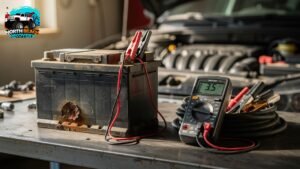
| Idling for hours with the tailpipe buried | Dead battery and carbon monoxide exposure | $150 to $350 for a battery |
| Driving off without a walkaround | Missed leaks, bent steering parts, and damaged brake lines | $400 to $1,800 |
Costs are estimated U.S. averages. Your vehicle, parts and region will move them.
A truck sunk to its frame, with a hot transmission and a driver who has already tried the bumper, is a different job. Rated rigging, snatch blocks and a trained spotter are what a vehicle recovery service brings, and none of them undo the hole you’ve already dug.
What Not to Do When Stuck Off-Road
If wheels do not make any more progress, stop driving. Stop, set parking brake and look before touching the throttle again.
Here is what not to do when stuck off-road, in the order drivers usually do it anyway:
- Don’t floor it. Spinning digs the axle deeper, and on clay it polishes the ground under the tire into something close to ice.
- Don’t leave the tires at street pressure. Dropping to about 15 PSI widens the footprint on sand, but stay above 12 PSI on stock wheels, because lower can unseat the bead and add a flat to your problems.
- Don’t stand in front of or behind the vehicle while someone else drives. A truck on a soft slope doesn’t stop when you want it to.
- Don’t run the engine with the tailpipe buried. Clear it first, every time.
- Don’t let the tide, the dark or the weather decide for you.
| Blue Tip: Use a three attempt rule. If the vehicle hasn’t gained a few feet after three controlled tries, you aren’t recovering, you’re digging. Stop and change the plan. |
How to Recover a Stuck Vehicle Off-Road Step by Step
Stop the wheels then clear the ground around the tires and tailpipe and add traction then back out along your own tracks.
- Stop and look. Check the lean, which wheels are buried, and whether the frame or a differential is resting on the ground.
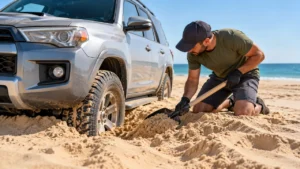
- Clear the tail pipe. Next, make shallow ramps in front of each drive tire down to the harder layer, but not only the top layer.
- Down the tires to give a wider footprint, but not below 12 PSI on original wheels.
- Place traction boards, a bag of kitty litter or, if necessary, floor mats in front of the drive tires. Mats rarely survive, so don’t sacrifice the nice ones.
- Back out slowly using even and light gas pressure. If it doesn’t move, rock it gently up and down in reverse and drive without spinning.
- After the third try, stop and call the vehicle recovery service, as a clean hole is a time-saving cut for the crew.
The surface changes the first move, so match your approach to the ground:
| Surface | What works first | What backfires |
|---|---|---|
| Sand | Air down, dig a ramp, and move onto firm, damp sand above the tide line | Spinning tires or parking below the high tide line |
| Mud | Place boards or kitty litter at the drive tires and use steady throttle | Packing the tread with mud, then forcing it |
| Snow | Clear the tailpipe, shovel to bare ground, and use light throttle | Idling for heat with the exhaust buried |
| Rock ledge | Use a spotter outside the vehicle and stack rocks under the low tire | Driving blind over the edge |
Off-Road Recovery Safety Tips for the Pull
Use only rated recovery points on the frame for attaching recovery gear and ensure no one is in the path of pull. A strapped or loaded cable holds energy and gives it out in a straight line, typically to the nearest person.
These off-road recovery safety tips come down to five checks before anything gets tight:
- Rated points only. Axles, suspension arms, bumpers and tow balls aren’t built for recovery loads, and a tow ball can snap off and travel a long way.
- Match the strap to the job. A kinetic rope stretches and suits a stuck pull. A tow strap doesn’t stretch and belongs on a rolling tow, not a snatch. Your winch line is not a tow line.
- Anchor low on something big. Have a tree strap near the base of a healthy trunk. Trails get closed when they have bare cable around a tree, which will kill the tree.
- Gloves, eye protection and a damper. Wrap a jacket (or recovery blanket) over the line to prevent a failure from whipping the jacket.
- Distance. Always stand more than the length of the strap away from the vehicles and never between the vehicles.
A vehicle recovery service has one individual operating the controls, and another on the outside, which is something most individual drivers are unable to achieve.
| Blue Tip: Before the strap tightens, agree upon a stop signal. The raised fist signal is used to stop everyone until the driver signals with a thumbs up. |
Stuck Vehicle Recovery at Night, in Snow, or on Tidal Sand
Safety is the top priority in a stuck vehicle recovery during times of darkness, snow and rising water.
Before starting the engine, clear the tailpipe of snow. If the exhaust is blocked, carbon monoxide can enter the vehicle cabin. In New York City in January of 1996, 21 individuals were treated with hyperbaric oxygen therapy for exposure to snow blockage of car exhausts.
Use hazard lights at night and do not stand close to traffic. Avoid running for long periods of time while shoveling.
If the water is rising on a beach, it is considered an emergency. Inform the vehicle recovery service on the exact location of the vehicle, distance to water and if the vehicle is leaning.
When to Call and When to Wait
If the car is leaning or in water, buried up to the axles, near traffic or leaking fluids then please call immediately. Only wait and work on it if the vehicle still moves or the ground is firm and no one is in danger.
Call now if:
- The lean is obvious from ten feet away
- Water is at or above the door sills
- The frame or differentials are resting on the ground
- You smell fuel or see a leak
- Traffic or an incoming tide is close
Try it yourself first if:
- The wheels still turn and the vehicle moves, even a few inches
- Firm ground is within a car length
- You have boards, a shovel or kitty litter on hand
We prefer that you spend 10 minutes with boards and a shovel, rather than pay for a pull that you didn’t need. If a truck has one tire spinning on hard ground, it’s typically a traction issue and not a recovery scenario. When you do call, choose a vehicle recovery service that will give you a recovery estimate before the hook is attached; otherwise you won’t have anything to offer in negotiations.
When a Vehicle Recovery Service Costs Less Than the Repair
A professional pull costs a fraction of what a failed attempt breaks. Our estimated rates start at $150 for a simple winch out and reach about $600 for deep sand or mud.
| Situation | Estimated price | Typical time on scene |
|---|---|---|
| Shallow ditch or soft shoulder, vehicle upright | $150 to $300 | 20 to 40 minutes |
| Buried to the axles in sand or mud | $300 to $600 | 45 to 90 minutes |
| Deep snow, steep embankment, or heavy truck | $400 to $800 | 1 to 2 hours |
| Trailer, RV, or work truck | $600 to $1,200 | 1 to 3 hours |
| After hours, holiday, or remote location | Add $75 to $200 | Varies |
The distance is not a determining factor in the cost of a vehicle recovery service, rather the difficulty of the pull. How deep their wheels are, how heavy their load is, and how close a truck can get. This is the one that counts. A pull from the wrong point can add $500 to $4,000 in repairs to a recovery you still have to pay for, which turns a $150 to $600 job into $650 to $4,600.
Many roadside plans limit the amount of winch out by distance from the road or by dollar limit – check the limit before relying on it. Then be sure to ask any vehicle recovery service for their rates, whether flat or hourly, if they have a minimum, and what the mileage rate is for towing.
What to Expect When Help Arrives
Crews will walk the scene before touching a hook. They note the lean, determine a rated recovery location, select an anchor and pull angle that won’t load the vehicle from side to side.
Dispatch needs five things from you:
- An exact location: GPS pin, mile marker or landmark
- Make, model and drivetrain
- How deep the wheels are and whether the vehicle leans
- Ground, weather and tide
- Any leaks, damage or injuries
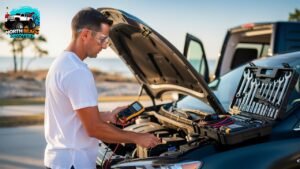
Before a vehicle recovery service hooks up, expect a walkaround and a price. Afterward, expect the same crew to point out anything that looks wrong. Do not pull off immediately after driving down the incline. Look for fluid under the car, feel for a pulling steering wheel, listen for grinding noises, remove mud trapped in the wheels, and test brakes at low speeds. An uneven tie rod or a brake line that has been nicked/broken does not scream in the sand.
| Blue Tip: Before making a call, send the GPS pin and take one photo of the wheels. A picture of the buried tires tells dispatch more than two minutes of description. |
Frequently Asked Questions
What is a common mistake during an off road recovery?
Turning the wheels when traction is lost. It hides the axle, it overheats the drive train and makes a pull into a more lengthy and expensive task. If you don’t make any progress at all, stop and review.
What to do if your car gets stuck in a ditch?
Switch on all lights, apply the parking brake and exit the vehicle to the side which is away from traffic. Don’t attempt to drive out of the car. If it is leaning in water or near the road call for help.
What are common mistakes when off roading?
Failure to change tyres, driving past the limits of traction, not understanding the tide or the weather, and lack of recovery equipment. The majority of stranded vehicles were stranded as a result of the driver continuing on soft ground.
How to avoid a car getting stuck in mud?
Tackle uncertain areas first, maintain a consistent pace over soft areas and avoid wet clay following rain. When mud begins to pack in the tread and the car begins to slow down, stop before the frame comes to the ground.
How much does it cost to recover a vehicle?
For a shallow ditch we charge an estimated amount of $150 to $300, deep sand or mud $300 to $600 and for snow or steep embankments $400 to $800. For hours after work and out of town locations, prices are $75 to $200.
What is a vehicle recovery service?
It’s a team of guys and gals that have winches, rated rigging and training that pull stuck or ditched vehicles back to land, and tow them when they are not safe to drive.
How fast can you get to me?
It will take a while to arrive depending on distance and access. Within the core service area, we estimate 45-90 minutes. Please provide an exact pin and include the ground and we will send you a window before we send.
Can you recover vehicles from beaches, soft shoulders and private land?
Yes. Vehicles can be recovered from sand, mud, snow, ditches and private land in locations that a truck can safely access or a winch line can be extended.
Which areas do you cover?
Call and let us know your location. Prior to dispatching anyone, we will discuss coverage and a time of arrival by phone.
Will my roadside plan or insurance pay for it?
Numerous plans will have a distance or dollar limit for winch outs. Please check with your provider to see what the limit is and be sure to keep a receipt and the location note for reimbursement.
Call Before You Spin the Tires Again
If you’re stuck, stop spinning and call. Call North Beach Recovery at +1 252-453-0573 or chase@northbeachrecovery.com. Please advise location, level-of-ground and if the vehicle is leaning, we’ll call you back and give you an estimate before we connect.
Sources:
- All-Terrain Vehicle Safety, U.S. Consumer Product Safety Commission: the source of 81,800 ATV injuries treated in emergency departments in 2018, and its safety guidance for riding off pavement.
- The 21 New York City carbon monoxide admissions and the escape of carbon monoxide from the vehicle exhaust system (as well as the estimated 500 CO deaths per year at the time) are attributed to the January 12, 1996, CDC MMWR article, Carbon Monoxide Poisonings Associated with Snow-Obstructed Vehicle Exhaust Systems.