Skip to content

Summarize with
Your car will not start and you are wondering if the battery is the problem. You hear clicking sounds when turning the key. The dashboard lights are dimmer than usual.
Car battery testing reveals whether your battery is healthy or failing. North Beach Recovery provides car battery service in Corolla and surrounding Outer Banks communities, helping drivers understand their battery conditions before emergencies strand them.
Battery related failures account for roughly 27 percent of all vehicle roadside assistance calls annually across America according to the Traffic Safety Administration.
Understanding your battery’s actual condition prevents unexpected breakdowns. Let’s explore how testing works and what the results tell you.
How to Test a Car Battery: The Complete Process
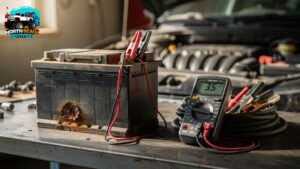
The battery testing process requires understanding that professional testing measures voltage or cold cranking amps and overall battery health. A quality multimeter reads voltage while the engine is off and running.
Professional testers provide more detailed information about battery condition than simple voltage checks. The entire testing process takes minutes but provides crucial information about your battery’s reliability. Basic testing starts with turning off your engine completely.
- Connect your multimeter to the battery terminals.
- The red probe touches the positive and the black probe touches the negative.
- A healthy battery reads approximately 12.6 volts when the engine is off.
- Below 12 volts indicates problems.
- Above 12.6 indicates an overcharging issue.
These readings guide your next decisions about whether your battery needs service or replacement.
Professional car battery service involves more thorough testing than what basic meters show. Technicians check cold cranking amps which measure how much current your battery produces when cold. They test battery health under load conditions. Mobile battery assistance can also provide convenient assistance when battery problems leave a vehicle unable to start.
They identify whether issues stem from the battery itself or the charging system. Professional testing prevents replacing a perfectly good battery when the real problem is your alternator.

Signs of a Weak Car Battery: Recognizing Failure Indicators
Signs of a weak battery range from obvious to subtle. Understanding what to watch for helps you catch problems early before they become emergencies.
Warning Signs Indicating Battery Problems:
- Slow engine cranking that increases over time
- Clicking sounds when turning the key with no engine start
- Dashboard lights that dim significantly during starting
- Battery warning light appearing on your dashboard
- Difficulty starting particularly in cold weather
- Corroded terminals visible around battery connections
- Battery case that appears bulged or damaged
- Electrical components like windows or locks responding slowly
- Car requiring multiple key turns to start
- Smell of rotten eggs near the battery area
Early detection of these signs prevents being abandoned at inconvenient times. Cold weather makes weak batteries worse because chemical reactions slow down.
If you notice starting problems in fall, get your battery tested before winter arrives. Waiting until January means freezing while waiting for roadside assistance.
Corrosion as a Critical Warning Sign
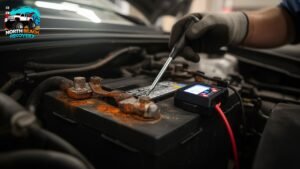
Blue, white, or green crusty material around battery terminals indicates corrosion that reduces electrical contact. This corrosion looks like powder covering the terminals.
Cleaning corrosion requires specialized knowledge to prevent damage. Don’t assume the battery needs replacement when corrosion might be the only problem. Professional testing determines what’s actually wrong.
Car Battery Service: When Professional Help Matters
Quality car battery service goes beyond simple testing.
- Professionals clean battery terminals removing corrosion that affects charging.
- They test your charging system to verify the alternator is working properly.
- They examine the battery case for damage or leaking.
- They discuss battery replacement if testing shows the battery is failing.
Professional service prevents wrong decisions based on incomplete information.
You need professional service when your battery frequently dies, when you see corrosion around terminals, or when testing shows borderline voltage.
Professionals prevent you from replacing batteries unnecessarily or ignoring charging system problems that damage batteries prematurely. They help you understand whether your battery or your charging system needs attention.
Battery terminals corrode from chemical reactions between lead and copper. This corrosion reduces electrical contact preventing efficient charging and power delivery.
Simple cleaning sometimes solves starting problems. Professional cleaning with proper materials restores electrical connection completely.
How to Check Car Battery Voltage: DIY Testing Guide
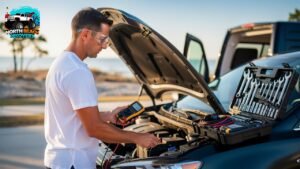
Car battery voltage checks involve a basic multimeter that costs $15 to $30 at hardware stores. The process is straightforward when you follow proper safety steps.
Your readings guide decisions about whether professional service or replacement is necessary. This simple test provides valuable information about your battery’s condition right now.
Gather your equipment first. You need a digital multimeter, safety glasses if you’re cautious, and access to your battery under the hood.
Ensure your vehicle is completely off and has been for at least five minutes. This allows chemical reactions to stabilize by providing accurate readings. Connect your multimeter properly to avoid damaging equipment or getting an electrical shock.
Steps for Safe Voltage Checking:
- Turn off your engine completely and wait a minimum of five minutes
- Locate the battery usually on the driver side under the hood
- Find the positive terminal marked with a plus sign or red color
- Find the negative terminal marked with a minus sign or black color
- Set your multimeter to DC voltage typically marked with V and a straight line
- Connect the red probe to the positive terminal first
- Connect the black probe to the negative terminal second
- Read the voltage display on your multimeter screen
- Record this off engine voltage reading completely
- Start your engine and record the running voltage
- Compare both readings to standard expectations
Readings below 12.4 volts with the engine off suggest your battery is weak. Readings below 12 volts mean your battery is dying.
Running voltage that drops lower than off voltage indicates charging system problems. These readings guide your next decisions about service or replacement.
How to Check Car Battery Voltage Under Load Conditions
Load testing checks your battery’s performance when your starter demands maximum current. This test reveals problems that simple voltage readings miss.
A battery might hold voltage perfectly under no load but fail completely when powering your starter. Load testing identifies this critical difference.
Professionals perform load testing using specialized equipment that creates an electrical load on your battery while measuring its response. As load increases, a healthy battery maintains voltage.
A weak battery voltage drops significantly under load. The amount of voltage drop indicates battery health. Significant drops mean replacement is necessary.
Battery Performance Standards by SAE establish battery testing standards including cold cranking amp ratings and reserve capacity measurements.
Book Your Car Battery Testing With Experts
Car battery testing results guide your decisions about replacement timing and charging system health.
Taking action based on test results prevents stranding and expensive roadside service calls. Replace proactively when testing indicates problems are approaching. Maintain clean terminals and proper connections. Test regularly especially before seasons that stress batteries.
North Beach Recovery helps Corolla and Outer Banks drivers understand their battery conditions. Call +1 252 453 0573 or email chase@northbeachrecovery.com. We test batteries thoroughly and recommend replacement only when necessary.
We test thoroughly and recommend only necessary service. Your vehicle reliability depends on battery health and we are here to help you maintain it.
FAQs About Car Battery Testing
How often should I test my car battery?
Most drivers test when they notice starting problems. Preventive testing makes sense annually especially before winter. Cold weather stresses batteries significantly so fall testing before winter is smart planning. Commercial vehicle operators might test every six months.
What’s the difference between testing and replacing a battery?
Testing measures current battery health. Replacing installs a new battery when the old one fails. Testing helps determine if replacement is actually needed or if other issues are causing problems. Don’t replace until testing confirms the battery is truly failing.
Can I test my battery myself without professional equipment?
Basic multimeter testing shows voltage providing preliminary information. Professional testing with load equipment reveals problems multimeters miss. DIY testing is worth doing but shouldn’t replace professional testing when you suspect problems. Use DIY testing as a first step then follow up professionally if concerns remain.
How long does battery testing take at a shop?
Professional testing normally takes 10 to 15 minutes. Quick voltage checks take five minutes. Comprehensive testing including load testing and cleaning takes 15 to 20 minutes. Most shops fit battery testing between other services efficiently.
What does battery warranty mean when buying new batteries?
Battery warranties generally cover faulty batteries for specific periods like 36 to 60 months. Warranty does not cover normal wear or abuse. Assurances vary significantly by manufacturer and battery quality. Ask about warranty details when purchasing replacement batteries.
Does a coastal climate affect battery life?
Salt air accelerates corrosion on battery terminals. Summer heat stresses batteries. Winter cold reduces battery effectiveness. Coastal batteries need more frequent inspection than inland batteries. Annual testing makes sense in our coastal environment.
Where can Outer Banks residents get battery testing?
North Beach Recovery provides professional testing throughout Corolla and surrounding communities. Call +1 252-453-0573 or email chase@northbeachrecovery.com. We test batteries thoroughly and recommend replacement only when necessary.
Are battery prices higher at the beach than mainland areas?
Battery prices are similar across coastal and inland areas. Shipping costs sometimes add slightly to coastal prices but differences are minimal. Focus on battery quality rather than shopping for the lowest prices. Quality batteries last longer despite slightly higher initial cost.
Sources
- Vehicle Roadside Assistance Data by NHTSA reports that battery related breakdowns account for approximately 27 percent of all vehicle roadside assistance calls annually. Proper battery maintenance and testing prevent the majority of these incidents through early problem identification and timely replacement.
- Society of Automotive Engineers – Professional testing following these standards accurately predicts battery reliability and remaining lifespan under various conditions.