Summarize with
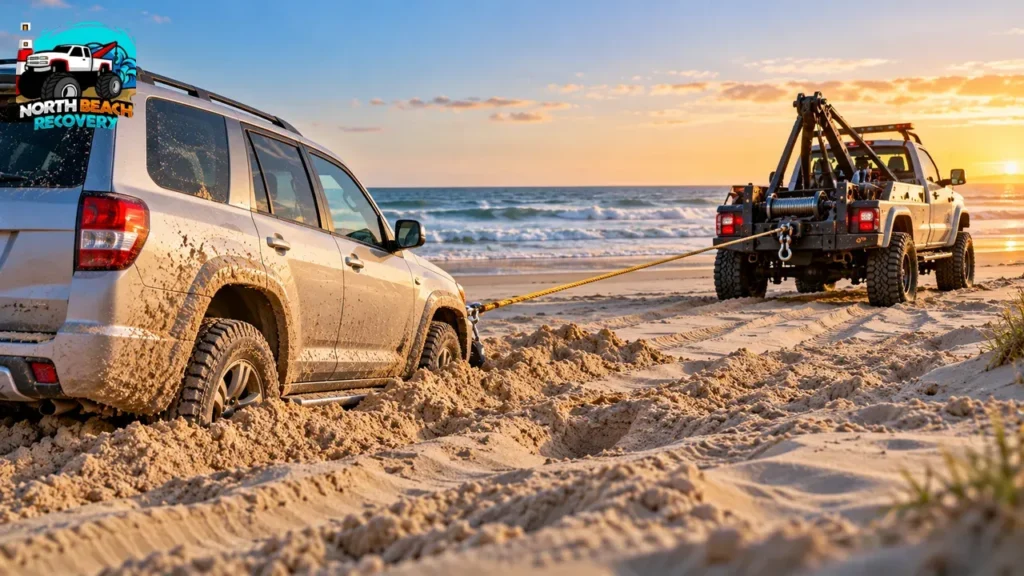
The first step of beach recovery in Corolla, NC, is to deflate the tires and get the vehicle back to hard sand with a strap or winch. A team of professionals selects the easiest possible means of achieving that goal without adding wheel spin. That will spare the drivetrain, as well as the frame.
The pavement on Corolla ends at the NC 12 intersection, and the county wants Four Wheel Drive past the intersection. A tire can be consumed quickly by fine dry sand. A professional vehicle recovery exists for exactly that moment.
Key Takeaways
- Stop the moment the tires dig. Extra throttle only buries the vehicle deeper.
- Corolla law caps tire pressure at 20 psi for most vehicles on the beach.
- In Corolla, NC, beach recovery is as dependent on the tide as it is on the equipment.
- Once on solid sand, check tires and underbody.
Stuck Vehicle Recovery Corolla NC Starts With Reading the Sand
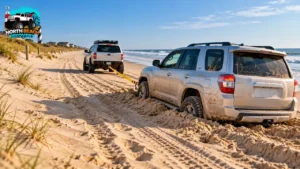
When tires begin to spin, they will not have much to hold on to if the road is fine, dry sand. The tire forms a trench, and the frame immediately follows, settling onto the surface in a matter of moments. Corolla, NC, stuck vehicle recovery crews first go through the process of determining why the vehicle has stopped. Near the dune line, the sand is loose and unlike damp sand near the waterline. Wet sand packs are compacted and become firm when the spinning tire jiggles the water out and softens the pack.
The problem changes with each season. The main lanes get deep ruts in them during the summer when there’s a lot of traffic. During the winter storms, this beach is rebuilt and leaves soft fresh sand near the ramps. High centering is the other trap. Once the frame or differential rides on the sand, the tires carry almost no weight. More throttle only polishes the hole.
Drivers who want to know what to ask before they book can read this guide on choosing a towing and roadside crew.
How Vehicle Extraction Works in Sand: Five Methods Compared
The process of extracting vehicles involves first reducing the resistance and then applying pull in a linear direction. When the light tools fail, crews resort to the heavy ones: winching.
| Method | Best for | Main risk | Who should do it |
|---|---|---|---|
| Airing down and reversing out | Light bogging with no frame contact | Tire bead can unseat at very low pressure | Driver |
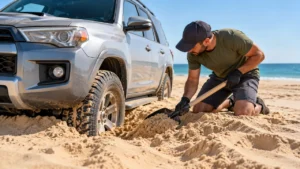
| Digging and traction boards | Tires buried but frame still clear | Boards can shoot out if the tire spins | Driver with the right gear |
| Strap or kinetic rope pull | Moderate bogging with a rated pull vehicle nearby | Snapped hardware under shock load | Experienced crew |
| Winch with a ground anchor | Frame hang or a deep trench | Misjudged anchor point | Professional crew |
| 4×4 wrecker with flotation tires | Heavy vehicles or a rising tide | Needs a safe approach path | Professional crew |
Most drivers can try the first two rows. The rest store serious energy in a stretched strap or cable and belong with trained hands. The amount of pull required also varies with sand. When buried to the frame, a vehicle requires a greater amount of force than is indicated by its weight. A crew sizes the line and the anchor before anything gets tensioned.
What Makes Beach Vehicle Recovery Corolla NC Different From a Road Tow?
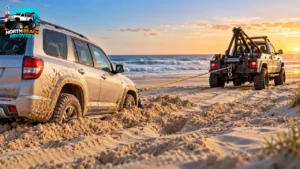
A standard tow truck sinks in soft sand and becomes a second stuck vehicle. Beach vehicle recovery in Corolla, NC needs a 4×4 recovery truck with wide flotation tires and a winch rated well above the load.
Gear matters too. Soft shackles replace steel ones because they store less dangerous energy. A snatch block doubles the winch pull when the vehicle sits deep. The approach route matters just as much. The crew parks the truck on hard sand and keeps the line as straight as the terrain allows. Driving over dunes is off limits locally, so crews work from the traveled lane along the beach.
Local Rules Affect Sand Vehicle Recovery Corolla NC Jobs
Currituck County will not allow 4WD on the beach and will limit the tire pressure of vehicles under 5000 lbs. curb weight to 20 psi while on the beach. Those rules shape how a crew prepares a vehicle before any pull. The county’s official beach driving rules tell drivers to use 4WD on the ramp and hold a slow, steady speed.
They also classify driving in the surf as reckless driving. After dark, the entire beach, including the parking areas, becomes a driving lane. That last rule changes night work. A stuck vehicle sitting in an open lane needs lights and a crew who watches for traffic.
Airing Up After Beach Recovery
Once the vehicle is free, the county directs drivers to air stations at Historic Corolla Park on the west side of NC 12. Proper beach recovery in Corolla, NC includes airing back up before the tires touch pavement.
How Do Tides Decide How Fast Vehicle Extraction in Corolla, NC Must Happen?
A vehicle stuck on a falling tide has hours to work with. One stuck on a rising tide may have minutes. Crews read the tide first and choose the method second. The NOAA tide station at Duck publishes predicted highs and lows and records water level every six minutes. Duck sits south of Corolla, so a crew treats those times as a guide and confirms conditions on the sand. Water can be pushed above the amount listed in the table by a strong northeast wind.
Near the full and new moon, the spring tides are higher than the rest of the month. Plan around them. Saltwater is the real danger. Water in the engine bay or the electronics can total a vehicle. A vehicle already in the surf becomes a water recovery, and the crew pulls it straight back along its own tracks.
| Tip 1: Screenshot the day’s tide table before you drive onto the beach. A crew can then match your stuck time to the tide without guessing. |
Beach Recovery Corolla NC Step by Step: What a Crew Does on the Sand
A recovery follows six steps from assessment to inspection. Failure to perform any one of them increases the likelihood of damage.
- Look at the tide and the position of the vehicle and select the strongest exit line.
- Move people clear of the wheels and the line path. Switch off accessories.
- Confirm tire pressure is at or under 20 psi and dig sand from around the tires and the frame.
- Rig the pull from a rated recovery point on the frame and set the truck or anchor on hard sand.
- Apply tension smoothly while the driver steers straight and uses throttle only on the crew’s signal.
- Move to firm ground and inspect the tires, underbody, and fluids before the next drive.
The driver’s job is small, but it matters. Remain in the vehicle unless otherwise instructed by the crew. Maintain a straight wheel on signal and release the brake gently.
| Pro Tip: Make sure to tell the crew what kind of drive you have and which wheels are in the ground when you call. Photos of the sand around each tire help them choose the right rig before they arrive. |
Which Mistakes Make a Stuck Vehicle Worse?
Spinning the tires after traction fades is the costliest mistake. It digs the trench deeper and heats the drivetrain. Other errors follow close behind. Drivers hook straps to ball hitches or bumpers that were never rated for a shock load. Others rock the vehicle with a friend’s truck and bury both. Pulling sideways across the trench is another one because the vehicle drags sand with it and the line loads unevenly.
Wild horses add a local twist. A House report on the Corolla Wild Horses Protection Act notes that a 1989 county ordinance makes it unlawful to lure a wild horse within 50 feet of any person. A crew pauses the pull if horses wander near the line.
| Tip 2: Do not leave the vehicle and keep children away from the wheels. Wait for the crew rather than walking the beach to find help. |
What Should You Weigh Before Calling for Outer Banks Beach Recovery?
Weigh equipment, local knowledge, speed, and vehicle condition. Those four factors predict how clean the pull will go.
Equipment match
A truck with flotation tires and a rated winch handles frame hang without extra strain. A two wheel drive wrecker does not.
Local knowledge
A crew that works the 4WD area knows where soft spots form near the ramps and the dune line. It also knows the county rules.
Tide awareness
A crew that asks about the tide before the first strap is thinking about the right risk.
Vehicle condition
Warning lights, odd noises, and earlier damage change where the crew attaches the line. Share all of it.
Post recovery checks
The best beach recovery Corolla NC jobs end with a look at the tires and underbody.
What to Bring for a Safe Corolla 4WD Beach Trip
Pack a tire gauge, a portable compressor, a shovel, and traction boards. They cover the first two recovery methods and make a crew’s job easier if you still end up stuck.
- A charged phone and a screenshot of the tide table
- A full fuel tank before you leave the pavement
- A check that your vehicle has solid frame mounted recovery points
- Water and warm layers for the wait since the beach has no shops or services
Quick Answers About Sand Recovery on the Outer Banks
These answers cover what drivers ask most when they sit stuck in Corolla sand. For instance, a driver who feels the tires almost moving often thinks one more push will work. It rarely does.
Can you drive your car on the beach in the Outer Banks, NC?
Yes, you can drive on designated beaches on the Outer Banks, North Carolina, where it is legal to drive a vehicle. Currituck County: Four Wheel Drive (4WD) is required on the beach in Corolla.
Which beach in Corolla, NC is considered the best?
There is no perfect beach in Corolla, North Carolina. The area provides a longer beach stretch which includes the beaches accessible with 4WD vehicles north of the end of the paved road on NC12. The best one will be based on your plans, access to the beach, and your desire for driving, relaxation, and/or a shoreline walk.
Can you drive your car on Corolla Beach?
Yes, you can drive on Corolla and Carova beaches north of where paved NC 12 ends, provided your vehicle meets local requirements. You must use 4WD and follow Currituck County’s beach driving rules. Check current access restrictions and beach conditions before setting out.
Are there any beach warnings for Outer Banks beach today?
Beach warnings may vary depending on the weather, surf, and coastal flooding conditions. Please consult the National Weather Service for any current weather and surf warnings and the Currituck County beach information page for local access information before driving onto the beach. Avoid using the old forecast to make a beach trip or recovery plans.
What are the beach conditions in Corolla, NC today?
Conditions on the beach in Corolla, NC can be different at different times of day, depending on the surf, wind, tides, and coastal flooding. Please refer to the local notices and tide forecasts prior to driving onto the 4WD Beach. If strong winds or rising tide make recovery of vehicles difficult, do not drive near the water line when unsafe.
Conclusion
The costliest mistake on Corolla sand is giving it more gas after the tires lose grip. So air down to 20 psi before you leave the ramp, screenshot the tide table, and stop the second you feel the wheels start to dig. If the frame is already sitting on the sand, or the water’s moving up the beach toward you, a shovel and a pair of traction boards probably won’t fix it.
That’s when it’s time to call for beach recovery in Corolla, NC. A crew with a 4×4 truck, flotation tires and a rated winch can pull you straight back to hard sand and check the tires and underbody before you drive off. After that, stop at the air stations at Historic Corolla Park and fill the tires before they touch NC 12 again.
Get Help From a Crew With 30+ Years on This Sand
North Beach Recovery handles stuck vehicles and dune recoveries, and surf pulls across Corolla’s 4WD area. Local beach recovery Corolla NC work is the core of what the team does.
Contact North Beach Recovery at +1 252-453-0573 or email chase@northbeachrecovery.com to discuss your specific needs. Thirty years on this sand teaches a crew where it softens first.
Sources
- Currituck County – Beach Driving and Parking Rules
Official county guidance covering 4WD requirements, tire pressure limits, beach driving lanes, and safety regulations. - NOAA Tides & Currents – Duck, North Carolina
Provides tide predictions and water-level information to help readers understand changing coastal conditions during vehicle recovery. - U.S. Government Publishing Office – Corolla Wild Horses Protection Act Report Provides congressional background on Corolla’s wild horses and related protection measures discussed in the recovery safety section.