Skip to content
Summarize with
Tire Repair Costs at a Glance
$25 to $45 for a shop puncture repair. $95 to $275 if someone has to come to you.
- Shop patch-plug repair: $25 – $45
- Mobile repair on paved roads: $95 – $175
- Mobile repair in the 4×4 beach zone: $150 – $275
- New passenger tire, installed: $160 – $300
- New SUV or light truck tire, installed: $220 – $450
A standard puncture repair on the northern Outer Banks runs $25 to $45 per tire at a shop. If the tire cannot be saved, a new passenger tire installed with mounting, balancing, and a valve stem runs $160 to $300, and an SUV or light truck tire runs $220 to $450.
Those numbers cover most of what rolls down Route 12. Corolla is not a typical tire market, though. A meaningful share of the vehicles that need a flat fixed here spend part of the week on unpaved sand north of the village, where there is no shoulder to pull onto and no shop to limp to. That changes both the kind of damage a technician finds and how the job gets priced.
What Does a Flat Tire Cost to Fix?
A quote covers three separate things: the repair itself, the labor to demount, remount, balance and reseat the tire, and disposal if the tire cannot be saved. Skipping any one of those steps is what turns a $35 patch into a failure six months later.
| Service | Typical Cost | What You Are Paying For |
|---|---|---|
| Shop puncture repair (patch-plug combo) | $25 – $45 | Demount, inspect, repair, rebalance |
| Mobile repair, paved roads | $95 – $175 | Includes the service call to reach you |
| Mobile repair, 4×4 beach zone | $150 – $275 | Beach access premium on top of the mobile rate |
| New passenger tire, installed | $160 – $300 | Mid-range all-season, mount, balance, valve stem |
| New SUV or light truck tire, installed | $220 – $450 | Larger sizes and higher load ratings |
| Tire disposal | $3 – $8 per tire | Often bundled into the installation price |
| After-hours or weekend premium | Add 25% to 50% | Nights, weekends, holidays |
Outer Banks rates sit above national averages because of seasonal demand and the cost of serving an area with limited access. Ask for an itemized estimate before work begins.
Can Your Tire Be Repaired, or Does It Need Replacing?
This is the question that decides whether you pay $35 or $300, and it is not a judgment call. The U.S. Tire Manufacturers Association sets a clear standard, and any shop worth using follows it.
A puncture is repairable only if all of these are true:
- The injury is no larger than a quarter inch (6mm) in diameter
- It sits in the tread area only, not the shoulder or sidewall
- The tire is removed from the wheel so the inner liner can be inspected
- The repair does not overlap any previous repair
- The tire does not already carry an improper repair, such as a plug pushed in from outside
Anything outside those limits means replacement, regardless of how new the tire looks. A sidewall cut is not repairable at any price. Neither is a tire with visible cord or belt exposure, and neither is one that has already been plugged from the outside, because that plug has been letting moisture at the steel belts since the day it went in.
Why Do Beach Punctures Cost More Than Highway Punctures?
A roofing nail in a driveway makes a clean, round hole that punches straight through the tread. That is the ideal repair case.
A broken oyster shell buried in wet sand, or a fragment of driftwood exposed at low tide, does something different. It tears rather than punctures, and a jagged tear often fails the quarter-inch test even when the visible opening looks small. That is why the average repair cost on the northern Outer Banks runs slightly higher than it does inland, where most flats come from nails and screws. More beach punctures end in replacement rather than repair.
There is a second factor, and it costs drivers more money than the shells do. Vehicles come off the 4×4 ramp and nobody airs the tires back up. A tire driven underinflated even for a short distance flexes internally in a way that can hide structural damage a patch will not fix. It is the single most common reason a $35 repair turns into a mandatory replacement here.
How Much Does Mobile Tire Repair Cost on the 4×4 Beach?
Mobile service in the beach zone runs $150 to $275, against $95 to $175 for the same job on a paved road. The premium covers real costs: a technician loads a service vehicle, airs down to drive on sand, and works outdoors instead of on a lift.
For anyone staying in Carova or Swan Beach without a usable spare, that premium is still the cheaper option, because a standard tow truck cannot reach unpaved beach roads at all. Getting a vehicle off the sand is a specialized recovery job, and our Corolla towing and beach recovery cost guide covers what that runs if the tire turns out to be unfixable on scene.
Worth confirming before you need it: not every company that advertises mobile tire service actually goes past the end of the pavement. Ask directly about beach-zone coverage rather than assuming.
Estimate Your Cost
Ballpark estimate only. A technician has to inspect the tire from the inside before anyone can tell you whether it is repairable. Call +1 252-453-0573 for a firm quote.
How Is a Tire Properly Repaired?
Seven steps, the same whether the vehicle rolled in off Route 12 or off the sand. Knowing them helps you tell a proper job from a shortcut.
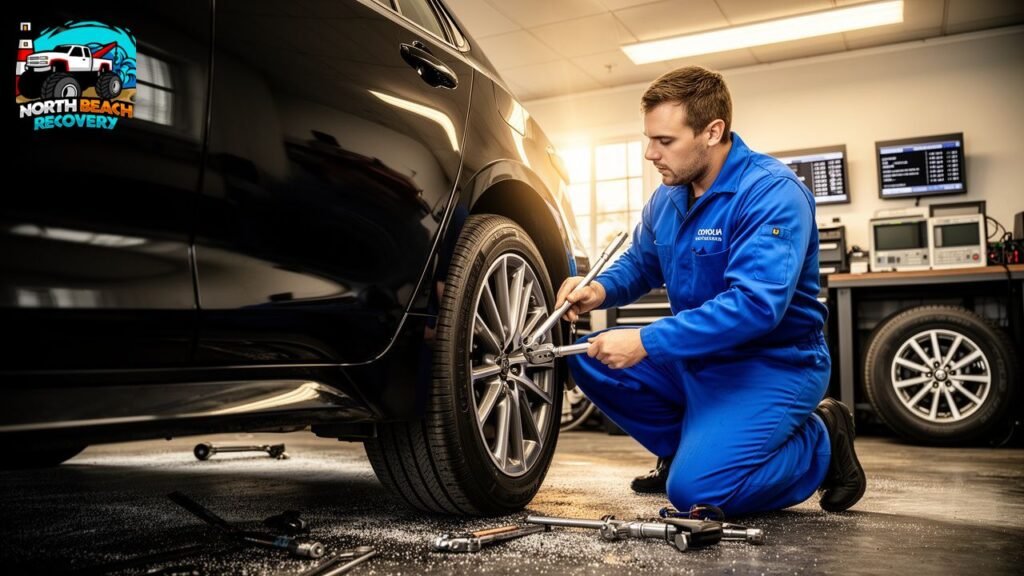
- Remove the tire from the vehicle and mark the puncture on the outside of the tread.
- Dismount the tire from the wheel completely. A repair done without removing the tire is not valid under any major manufacturer’s warranty.
- Inspect the inner liner for hidden damage, including belt separation and moisture intrusion that does not show from outside.
- Ream and clean the puncture channel so the repair unit can bond properly.
- Apply a combination plug-patch from the inside, sealing both the puncture channel and the inner liner in one piece.
- Remount and inflate to the manufacturer’s recommended pressure, then check for leaks with a soap-water test.
- Rebalance the wheel before it goes back on the vehicle.
What Mistakes Make a Repair Cost More?
Pushing in a plug from the outside. The most common money-saving attempt, and the most expensive one. It seals the leak temporarily but leaves the steel belts exposed to moisture, which corrodes them over the following weeks. A tire that arrives at a shop with an outside plug in it usually has to be scrapped.
Driving on a slow leak. A few days at low pressure builds internal heat damage that no patch fixes. If the pressure light comes on, check it that day rather than at the end of the week.
Skipping the internal inspection. Some quick-service shops repair without demounting to save time. That misses exactly the damage that causes a repair to fail later.
Forgetting to air back up after the beach. Covered above, and worth repeating because it is the local one.
Do You Need a Permit to Drive on the Corolla 4×4 Beach?
No permit is required to drive on the beach, but the vehicle must be registered, licensed, and insured. Parking is different. Currituck County requires a county-issued Beach Parking Permit to park on the sand from the second Saturday in May through the last Saturday in September. Rental guests usually get one through their management company, and weekly visitor permits are sold in limited numbers.
The county also publishes specific tire pressure guidance for the off-road ramp, and following it prevents most of the tire damage covered on this page: 20 PSI for SUVs and half-ton 4×4 vehicles, 35 PSI for three-quarter ton vehicles. Air stations are available at Historic Corolla Park, which is also where to air back up on the way out.
Common Questions
Is a plug-only repair ever acceptable?
No. Both the USTMA and the Tire Industry Association classify a standalone plug as a temporary measure to reach a shop, never a permanent fix. A proper repair seals the puncture channel and the inner liner together.
How long does a tire repair take?
Twenty to forty minutes once the vehicle is on the lift, not counting wait time during peak season. A mobile job on the beach takes longer because of drive time on sand.
Can a tire be repaired more than once?
Yes, if the new puncture does not overlap or sit too close to the previous repair, and the tire has not already been repaired twice. Most shops decline a third.
Does tire size affect repair cost?
Barely, because the labor is nearly identical across sizes. Replacement cost is a different story and rises sharply with larger truck and SUV tires.
Does beach driving void a tire warranty?
Not by itself. What can void it is damage from underinflation or overloading, both of which a manufacturer can usually identify on inspection.
Are punctures more common on the beach than on paved roads?
Not necessarily more common, but more often unrepairable. Shell fragments and driftwood tear the tread, while road debris tends to make the clean punctures that patch well.
Will my roadside plan cover a flat on the 4×4 beach?
Often not. Many plans exclude service off paved, state-maintained roads, which is exactly where the beach zone sits. Our guide to roadside assistance costs and coverage explains what the different plan types actually include.
What if the tire cannot be fixed and I am stuck on the sand?
Then it becomes a recovery job rather than a tire job. See our towing cost breakdown for what that involves.
Get a Flat Fixed in Corolla
North Beach Recovery handles tire repair and installation for both shop and mobile jobs across Corolla and the northern Outer Banks, including the unpaved 4×4 communities where standard roadside service will not go. Every tire gets inspected from the inside before a repair is quoted, so nobody pays for a patch on a tire that actually needs replacing.
Call +1 252-453-0573 or email chase@northbeachrecovery.com.
Sources
- U.S. Tire Manufacturers Association — tire repair standards, quarter-inch limit, and demounting requirements
- Currituck County — beach driving and parking permit rules, official tire pressure guidance
- SearchTires — tire price and installation cost data by vehicle category
- Lemonade — puncture repair cost ranges